
Whether it’s Frank’s Red Hot, Huy Fong’s signature sriracha, or the devilish Da Bomb, hot sauce can elevate an otherwise okay dish to the next level. A spicy kick that tantalizes the taste buds and beats your heart into submission. Peppers have the power to set your senses on fire with a potent punch of flavor and flailing limbs desperately reaching for the relief only the tallest glass of milk can bring. And when that doesn’t work, all you can do is sit there and sweat it out.
In an interview with ABC news, Sean Evans, creator and host of Hot Ones (it’s the show with hot questions and even hotter wings), explained how the hellfire of peppers can turn to poetry for fans of his guests from Gordan Ramsay to Doja Cat.
“Hot sauce humanizes people you see who are always on red carpets in front of flashing bulbs behind, you know, black car windows. And then here they are sweating their faces off, spitting in buckets and then trying to survive this freak show.”
But long before celebrities promoted projects on a blank soundstage next to a spittoon for YouTube clicks (as everyone predicted would happen), an American pharmacist Wilbur Scoville invented a rudimentary heat index known as the Scoville scale in 1912.
Wilbur’s strategy wasn’t exactly scientific, with the test consisting of mixing the extract of capsaicin oil from a pepper with a solution of sugar water. Capsaicin provides peppers with their signature heat and delightful, endorphin-inducing pain. Wilbur would then simply give the mixture to a human test subject and dilute the heat further and further until it could no longer be detected. In short, like a mad waiter spinning a possessed pepper grinder, Wilbur would wait for you to say when, if you could cough the words out.
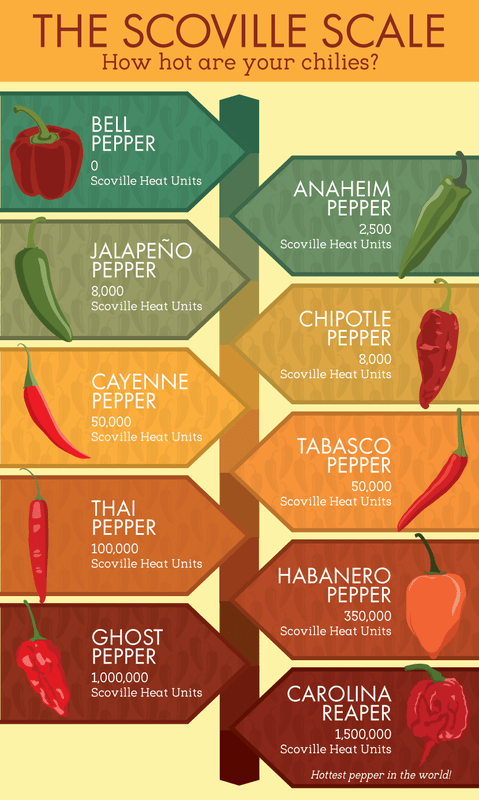
A common bell pepper would register a zero on the scale, while the haunting ghost pepper slams the giant wooden mallet down and shatters the bell, featuring one million face-melting Scoville Heat Units (SHUs). That’s 170 times hotter than Tabasco sauce.
While a guy named Wilbur from Connecticut under the Woodrow Wilson administration doesn’t sound like the ideal candidate to rate spicy peppers, the Scoville scale remains the benchmark for choking on chilis and bottled lava. Sure, there’s the more modern technique known as High-Performance Liquid Chromatography (HPLC), but the name doesn’t exactly roll off the tongue like a scotch bonnet Scoville rating.
So before you pick your punishing pepper, be sure to take a look at Wilbur’s scale to see how much heat you can handle:
 Kevin David Creative
Leave a comment